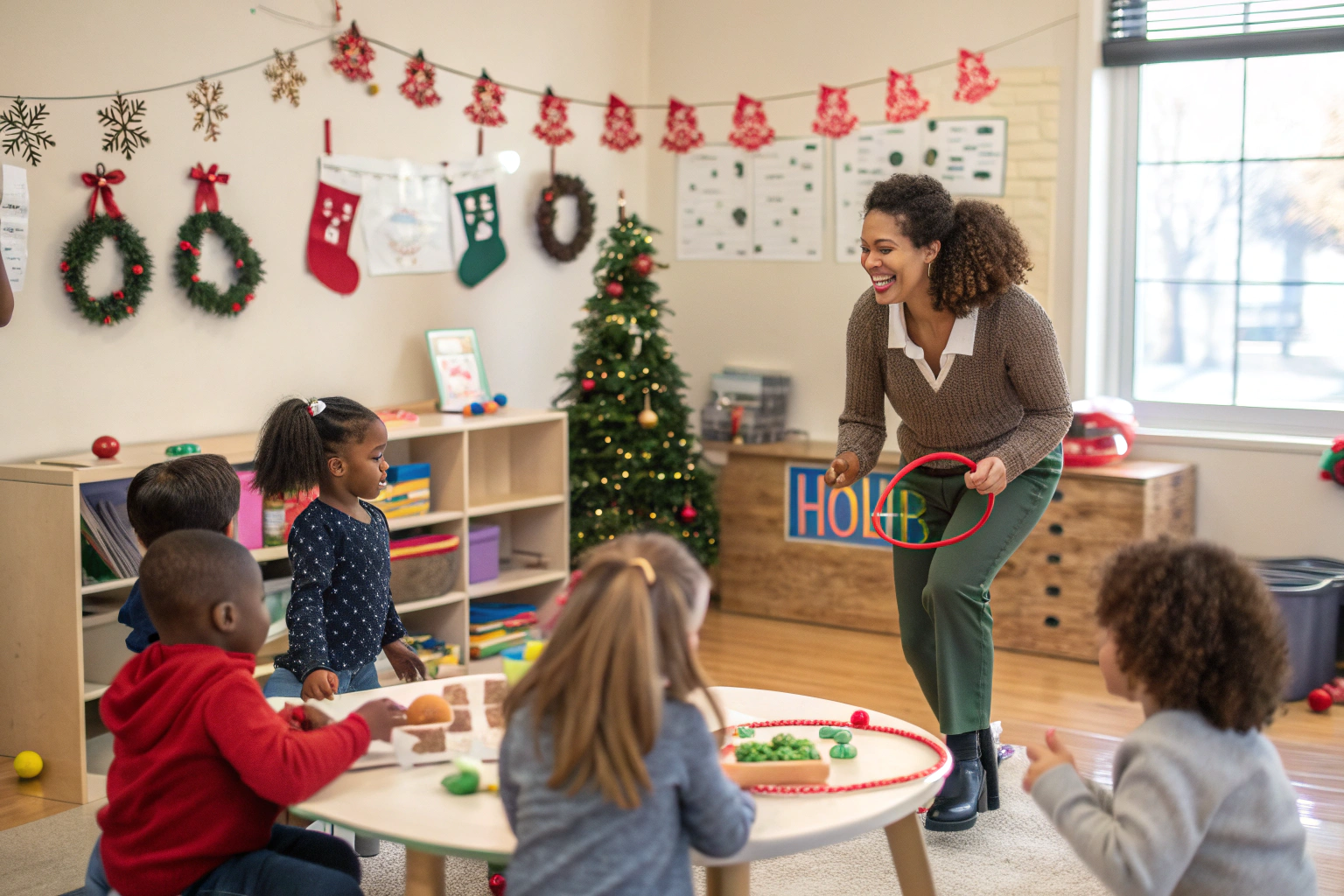
Christmas games for kindergarten are fun, festive activities designed for children aged 4 to 6. These games help develop motor skills, promote social interaction, and reinforce learning concepts like counting and color recognition in an exciting holiday context. They are typically simple to understand and play, using festive themes like reindeer, Santa, and snowmen to keep young children engaged and entertained during the holiday season.
Key Benefits at a Glance
- Develops Key Skills: Enhances fine motor skills through activities like threading ornaments, gross motor skills with reindeer relay races, and crucial hand-eye coordination.
- Promotes Social Learning: Fosters positive social interaction by encouraging teamwork, fair turn-taking, and listening to directions in a playful group setting.
- Simple and Low-Cost: Most games require minimal preparation and use common, inexpensive supplies like paper, cotton balls, or candy canes, saving you time and money.
- Adaptable and Inclusive: Easily modified for different group sizes, diverse ability levels, and physical spaces, ensuring every child can participate successfully and feel included.
- Boosts Holiday Spirit: Creates a joyful and memorable classroom or party atmosphere, instantly making learning and playing feel like a festive celebration.
Purpose of this guide
This guide is for teachers, parents, and caregivers looking for simple yet engaging holiday activities for young children. It solves the challenge of finding age-appropriate games that are both fun and educational, without requiring extensive setup or expensive materials. Inside, you’ll discover step-by-step ideas for tried-and-true Christmas games, get tips on adapting them for your specific group, and learn common mistakes to avoid, like overly complicated rules that can frustrate young players. Ultimately, this guide helps you create a festive, stress-free experience that supports childhood development and builds happy holiday memories.
As a kindergarten educator with over a decade of classroom experience, I’ve witnessed firsthand how christmas games for kindergarten can transform the chaotic energy of December into meaningful learning opportunities. The holiday season brings unique challenges to early childhood classrooms – heightened excitement, shortened attention spans, and the delicate balance between celebration and education. Through years of trial and refinement, I’ve discovered that thoughtfully selected Christmas games serve as powerful tools for maintaining classroom harmony while fostering essential developmental skills. These activities don’t just occupy time; they create joyful learning experiences that children remember long after the tinsel is packed away.
Why Christmas games are essential in kindergarten
The connection between christmas games for kindergarten and developmental milestones runs deeper than simple entertainment. During my years in early childhood education, I’ve observed how festive activities naturally align with kindergarten learning objectives while addressing the social-emotional needs of young children during this stimulating season. Holiday learning becomes most effective when games incorporate the excitement children already feel about Christmas, channeling that energy into productive skill development.
Research consistently shows that play-based learning accelerates cognitive development in kindergarteners. When we wrap academic concepts in holiday cheer, children engage more readily and retain information longer. The familiar Christmas context provides emotional security that allows children to take learning risks and explore new concepts with confidence.
| Developmental Area | Christmas Game Benefits | Kindergarten Skills Addressed |
|---|---|---|
| Social-Emotional | Turn-taking, cooperation | Sharing, following rules, emotional regulation |
| Cognitive | Memory, problem-solving | Critical thinking, pattern recognition, sequencing |
| Physical | Gross and fine motor | Coordination, balance, hand-eye coordination |
| Language | Vocabulary, listening | Communication, phonics, comprehension |
Christmas games also provide crucial opportunities for emotional regulation during a season that can overwhelm young children. The structured nature of games creates predictable routines within the holiday excitement, helping children feel secure while celebrating.
Quick and easy no prep Christmas games
Time constraints during the holiday season challenge even the most organized educators. These no-prep christmas activities address that critical pain point by requiring zero preparation time while delivering maximum engagement. Each game uses common classroom items or no materials at all, making them perfect solutions for unexpected schedule changes and transition moments.
Build foundational literacy through play—rhyming games boost phonemic awareness just like these holiday activities: Rhyming Games for Kindergarten.
- All games require zero preparation time
- Use only common classroom items or no materials
- Perfect for unexpected free time or transitions
- Can be implemented immediately with any group size
The beauty of these easy kindergarten games lies in their immediate accessibility. When plans change suddenly – a common occurrence in December – these activities provide instant engagement without scrambling for materials or lengthy explanations.
Reindeer reindeer Rudolph a Christmas circle game
This christmas circle games adaptation of the classic “Duck, Duck, Goose” has become one of my most reliable reindeer games for managing energy levels. Children sit in a circle while one child walks around tapping others’ shoulders, saying “Reindeer, reindeer, reindeer” until choosing someone as “Rudolph.” The selected child then chases the tapper around the circle, creating exactly the right amount of active kindergarten games excitement.
The setup requires absolutely no materials and no preparation time. I’ve used this game successfully with groups ranging from eight to twenty-five children. The familiar structure helps children feel confident while the Christmas theme maintains their interest. What I appreciate most is how naturally it regulates classroom energy – children release physical tension while practicing self-control and turn-taking.
The game addresses multiple developmental areas simultaneously. Gross motor skills develop through running and spatial awareness, while social skills grow through turn-taking and good sportsmanship. I’ve noticed that shy children often participate more readily in this familiar game format with a festive twist.
Santa says a Christmas twist on a classic
Santa says game transforms the traditional “Simon Says” into a powerful tool for following directions and listening skills development. This interactive games format requires no materials while providing excellent practice in auditory processing and impulse control.
- Have children stand in a circle or scattered around the room
- Give commands starting with ‘Santa says…’ (children follow)
- Give commands without ‘Santa says’ (children should not follow)
- Children who move incorrectly sit out one turn
- Continue until energy is appropriately regulated
The Christmas-themed actions make this game particularly engaging for kindergarteners. Instead of generic movements, children “wrap presents” by making circular motions with their arms, “feed reindeer” by pretending to scatter food, or “ring jingle bells” by shaking their hands above their heads.
- Use Christmas actions: ‘wrap presents’, ‘feed reindeer’, ‘ring jingle bells’
- Start slowly and increase pace as children get comfortable
- Include quiet actions to calm excited groups
- Let children take turns being ‘Santa’ for leadership practice
I’ve found this game invaluable for transitioning between high-energy and quiet activities. When children return from recess overstimulated, a few rounds of Santa Says with calming actions like “Santa says tiptoe like elves” effectively brings the group back to learning readiness.
Christmas freeze dance
Christmas movement activities like freeze dance combine music games with physical activity to create engaging kindergarten freeze dance experiences. This game requires only a music source and seasonal songs to transform any space into an active learning environment.
The rules remain simple: children dance freely while Christmas music plays, then freeze like statues when the music stops. I enhance the basic format by calling out specific poses during freeze moments – “Freeze like a Christmas tree!” or “Freeze like you’re wrapping a present!” These variations add cognitive challenges while maintaining the physical activity benefits.
“Kindergarten educators stated that musical games such as Christmas Musical Chairs resulted in a 76% increase in students’ positive engagement and group cooperation during December activities.”
— My Teaching Cupboard, November 2025
Source link
Song selection significantly impacts the game’s success. I prefer instrumental Christmas music that allows for easy stopping and starting, though familiar carols work well when children know the words. The key is choosing music with clear rhythms that inspire movement while remaining appropriate for the classroom setting.
Christmas word game
The christmas word game using letters from “Merry Christmas” serves as both a vocabulary building exercise and spelling practice opportunity. This literacy activity works as a quick time-filler or extended center activity, demonstrating remarkable flexibility in implementation.
Children receive the letters M-E-R-R-Y C-H-R-I-S-T-M-A-S and create as many words as possible using only those letters. Kindergarteners might find simple words like “me,” “my,” “is,” and “at,” while more advanced students discover “merry,” “Christmas,” “smart,” and “chart.” The activity naturally differentiates based on individual ability levels.
I often use this game during indoor recess or when we have unexpected extra time. The competitive element motivates children while the educational value satisfies curriculum requirements. Modifications include working in pairs for peer support or using picture clues for emerging readers.
Educational Christmas games for kindergarten skill development
Educational games during the holiday season maintain academic momentum while embracing the celebratory atmosphere. This “stealth teaching” approach embeds learning objectives within festive learning experiences, addressing concerns about educational value while preserving student enjoyment. Skills development continues naturally when children don’t realize they’re working on holiday learning objectives.
Reinforce number sense during the holidays with festive counting challenges: Counting Activities for Kindergarten.
| Game | Primary Skill | Materials Needed | Time Required |
|---|---|---|---|
| Jingle Bell Count and Sort | Math concepts | Colored jingle bells, sorting trays | 15-20 minutes |
| Santa’s Workshop Letter Match | Literacy skills | Letter cards, Christmas images | 10-15 minutes |
| Holiday Bingo | Visual discrimination | Bingo cards, markers | 20-25 minutes |
The effectiveness of these games lies in their ability to disguise rigorous learning within enjoyable activities. Children eagerly participate because the games feel like play, yet they’re developing essential academic skills that support their overall kindergarten success.
Jingle bell count and sort a math activity
This math christmas games combines tactile learning with fundamental mathematical concepts through counting activities and sorting games. The sensory appeal of jingle bells creates an engaging entry point for children who might otherwise resist math instruction.
- Provide each child with 10-15 jingle bells in 3-4 colors
- Start with simple sorting by color into separate containers
- Progress to counting bells in each color group
- Create simple patterns using different colored bells
- Challenge advanced students with addition problems using bell groups
The multi-sensory nature of this activity supports different learning styles while addressing various mathematical concepts. Visual learners benefit from the color sorting, auditory learners enjoy the jingling sounds, and kinesthetic learners engage through hands-on manipulation. I’ve observed children naturally discovering mathematical relationships as they explore the materials.
Extensions include graphing activities where children record their sorting results, measurement activities using bells as non-standard units, and pattern extension challenges. The materials store easily and can be reused throughout the holiday season for different mathematical explorations.
Santa’s workshop letter match a literacy game
Literacy christmas games like Santa’s Workshop Letter Match transform letter recognition practice into an exciting North Pole adventure. This phonics activities game addresses multiple literacy skills while maintaining high engagement through its thematic connection to children’s Christmas interests.
The game setup involves creating letter cards and corresponding Christmas-themed picture cards that begin with each letter. Children match uppercase letters to lowercase letters, letters to beginning sounds, or letters to picture cards depending on their developmental level. The Santa’s workshop theme provides meaningful context that helps children remember letter-sound relationships.
Implementation flexibility makes this game particularly valuable. It works effectively as a whole-group activity with teacher guidance, a small-group center rotation, or individual practice during choice time. I’ve seen reluctant readers eagerly participate when the activity connects to their Christmas excitement.
Differentiation occurs naturally as children self-select appropriate challenge levels. Beginning readers might focus on matching identical letters, while more advanced students work with beginning sounds or even simple word building. The key is providing multiple entry points while maintaining the engaging Christmas theme.
Holiday bingo for kindergarten
Christmas bingo adapts the traditional game format for kindergarten developmental levels by using pictures instead of numbers. This modification supports visual discrimination skills while building holiday vocabulary in an accessible, engaging format perfect for party games settings.
- Use pictures instead of numbers for non-readers
- Include familiar Christmas symbols: tree, star, candy cane, snowman
- Call out items slowly and show picture cards
- Allow children to help each other find images
- Celebrate multiple winners to maintain engagement
The social aspects of bingo support community building while academic skills develop naturally. Children practice visual scanning, listening skills, and vocabulary recognition while experiencing the excitement of potential victory. I’ve found that kindergarteners particularly enjoy the anticipation and celebration aspects of bingo games.
Modifications include using different vocabulary sets for various themes, creating personalized bingo cards based on student interests, or incorporating movement by having children act out the called items. The versatility of bingo makes it suitable for different group sizes and time constraints.
Sensory Christmas games for kindergarten
Sensory play supports brain development and learning readiness, becoming particularly valuable during the overstimulating holiday season. Christmas sensory play provides calming, focused activities that help children regulate their emotions while developing fine motor skills essential for academic success.
- Sensory play supports brain development and learning readiness
- Particularly calming during overstimulating holiday season
- Develops fine motor skills essential for writing
- Encourages scientific thinking through exploration
Sensory activities offer children opportunities to explore materials through touch, smell, and manipulation while building neural pathways crucial for later academic learning. The Christmas theme adds excitement to these developmentally appropriate experiences.
Find the jingle bell sensory bin
This sensory bins activity creates an engaging treasure hunt that develops fine motor development while providing calming sensory input. Children search through various materials to locate hidden jingle bells, combining tactile exploration with problem-solving challenges.
| Base Material | Benefits | Safety Notes |
|---|---|---|
| Rice (uncooked) | Good texture, inexpensive | Monitor for allergies |
| Shredded paper | Recyclable, safe | Use white/green for Christmas theme |
| Pom poms | Soft, colorful | Ensure size appropriate for age |
| Pasta shapes | Interesting textures | Supervise to prevent eating |
The setup involves filling a large container with the chosen base material and hiding jingle bells throughout. Children use their hands to search, developing tactile discrimination skills while experiencing the satisfaction of discovery. The jingling sound provides auditory feedback that enhances the sensory experience.
I’ve observed children naturally developing scientific thinking through this activity. They make predictions about where bells might be hidden, test their hypotheses through exploration, and draw conclusions about effective search strategies. These cognitive processes occur naturally within the enjoyable sensory experience.
Guess the Christmas smell game
Sensory discrimination develops through this olfactory exploration game that builds vocabulary while creating positive associations with christmas smells. This unique sensory experience connects children to Christmas traditions through familiar seasonal scents.
- Cinnamon sticks – warm, spicy Christmas scent
- Peppermint extract on cotton balls – holiday candy connection
- Pine needles or branches – Christmas tree association
- Vanilla extract – cookie baking memories
- Orange peels – traditional holiday fruit
The game involves placing different Christmas-associated scents in small containers with holes in the lids. Children smell each container and guess the scent, developing olfactory discrimination while building descriptive vocabulary. The activity often triggers memory connections and storytelling opportunities.
- Check for allergies before introducing any scents
- Use small amounts to avoid overwhelming sensitive noses
- Supervise closely to prevent ingestion
- Have unscented option for children who prefer not to participate
Safety considerations are paramount with this activity. Always check for allergies and sensitivities before implementation. Some children may find certain scents overwhelming, so providing alternatives ensures inclusive participation.
Classroom Christmas party games for large groups
Managing large groups of excited kindergarteners during christmas celebrations requires specific strategies and carefully selected large group activities. These classroom party games ensure inclusive participation while maintaining classroom management during holiday celebrations.
Pair your celebration with a seasonal craft that develops fine motor skills: Gingerbread House Craft for Preschool.
- Establish clear signals for attention before starting
- Have backup activities ready for varying energy levels
- Include all children regardless of skill level
- Keep games short to maintain engagement
- Plan for easy transitions between activities
The unique challenges of holiday parties – heightened excitement, time constraints, and diverse participation needs – require games specifically designed for these circumstances. Success depends on careful planning and flexible implementation.
“Of surveyed elementary teachers, 82% introduced games like Christmas Bingo and Pin the Nose on the Snowman to reinforce teamwork and sensory skills during holiday classroom celebrations.”
— The Printable Princess, October 2025
Source link
Pass the Christmas present game
This passing games adaptation creates excitement while building community through shared anticipation. Similar to Hot Potato, children pass a wrapped box while Christmas music plays, with the child holding the “present” when music stops receiving a small treat or privilege.
The musical games format naturally creates suspense and engagement while practicing listening skills and turn-taking. I modify the traditional elimination format by ensuring every child receives something positive, whether they’re holding the present or not. This approach maintains excitement while supporting inclusive classroom values.
Implementation requires minimal materials – a wrapped empty box and Christmas music. The game works effectively with groups of any size and can be adjusted for different time constraints. The key is managing the excitement level through music selection and celebration style.
Pin the nose on Rudolph
This rudolph game adaptation of the classic party game develops spatial awareness while maintaining familiar game structure. Children attempt to place Rudolph’s red nose in the correct position while blindfolded, creating excitement through the challenge of spatial orientation.
Material creation involves drawing or printing a large Rudolph face and creating red paper noses with tape or magnets for attachment. The familiar game format helps children feel confident while the Christmas theme adds seasonal excitement. Turn-taking practice occurs naturally as children wait for their attempts.
I’ve observed that kindergarteners particularly enjoy the anticipation and humor of this game. The spatial challenges support mathematical thinking while the social aspects build classroom community. Modifications include using larger targets for easier success or allowing peek privileges for children who find blindfolding uncomfortable.
Decorate a tree relay
This energetic relay combines teamwork with decoration activities as teams race to decorate their designated “Christmas tree” – a volunteer child – with paper ornaments. The activity develops cooperation skills while providing appropriate physical activity for party settings.
- Divide class into 2-3 teams of equal size
- Select one child from each team to be the ‘Christmas tree’
- Give each team a collection of paper ornaments with tape
- Teams race to decorate their ‘tree’ person with ornaments
- Celebrate all teams for creativity and teamwork
The game’s success depends on emphasizing creativity and teamwork over speed or winning. I focus celebrations on unique decoration choices, helpful teammates, and patient “trees” rather than which team finishes first. This approach maintains excitement while supporting positive social development.
Material preparation involves creating paper ornaments in advance – stars, bells, candy canes, and other Christmas shapes work well. Using tape allows easy attachment and removal, while the decoration process provides opportunities for creative decision-making and collaborative problem-solving.
Quiet Christmas activities for small groups and centers
Balancing high-energy and quiet activities during the holiday season requires thoughtfully planned christmas centers and small group activities. These quiet games provide focused learning opportunities while managing classroom energy levels effectively.
| Activity | Group Size | Supervision Level | Skills Developed |
|---|---|---|---|
| Christmas Cookie Counting | 2-4 children | Independent | Number recognition, sorting |
| Build a Snowman Sequence | 2-3 children | Minimal guidance | Sequential thinking, ordinal numbers |
| Disappearing Snowman Word Game | 3-4 children | Teacher-led | Spelling, word recognition |
These playtime ideas serve dual purposes – providing meaningful learning experiences while offering calmer alternatives to high-energy activities. The Christmas themes maintain holiday excitement within manageable activity formats.
Christmas cookie counting math center
This independently-run math centers activity uses paper “cookies” with varying numbers of decorations for number recognition and comparison practice. Children sort cookies by decoration count, order them numerically, and compare quantities using mathematical language.
The center setup involves creating paper cookies with different numbers of drawn-on decorations – chocolate chips, sprinkles, or icing designs work well. Children manipulate these materials independently, developing mathematical thinking through hands-on exploration. The familiar cookie context makes abstract number concepts more concrete and understandable.
I’ve observed children naturally developing mathematical vocabulary through this center. They use terms like “more,” “less,” “equal,” and specific number names as they work. The self-directed nature builds independence while the mathematical challenges support curriculum objectives. Extensions include simple addition problems using multiple cookies or creating patterns with different decoration types.
Build a snowman sequence game
Sequencing activities like this snowman game develop logical thinking while reinforcing ordinal numbers through hands-on manipulation. Children arrange picture cards or felt pieces to build a snowman in the correct sequence, practicing step-by-step thinking processes.
The materials include cards or pieces showing snowman construction steps – rolling snowballs, stacking them largest to smallest, adding accessories like hat, scarf, and buttons. Children work together to determine the logical order, discussing their reasoning and making adjustments as needed.
This activity naturally generates mathematical discussions about size, order, and sequence. Children use ordinal number vocabulary – first, second, third – while building understanding of logical progression. The collaborative nature encourages peer learning and communication skill development.
Disappearing snowman word game
This positive alternative to traditional hangman creates a more supportive learning environment while building word recognition and spelling game skills. Instead of adding body parts to a gallows, children remove parts from a complete snowman drawing with each incorrect guess.
The literacy activity uses Christmas and winter vocabulary appropriate for kindergarten levels. Word lists might include “snow,” “cold,” “mittens,” “cocoa,” or other familiar terms. The visual representation helps children understand word structure while the guessing format maintains engagement.
I prefer this variation because it eliminates the negative imagery of traditional hangman while maintaining the strategic thinking aspects. Children develop letter-sound relationships, spelling patterns, and vocabulary recognition through this themed games format. The snowman imagery connects to seasonal interests while supporting academic skill development.
Inclusive Christmas games for all abilities
Ensuring meaningful participation for all kindergarteners requires mindful game design that accommodates diverse learners while maintaining holiday spirit. These inclusive christmas activities and accessible games provide multiple participation methods regardless of developmental differences or physical abilities.
- DO: Offer multiple ways to participate in each game
- DO: Focus on effort and participation over winning
- DO: Adapt rules to ensure everyone can succeed
- DON’T: Single out children who need accommodations
- DON’T: Use elimination-style games that exclude children
- DON’T: Assume all families celebrate Christmas the same way
Inclusive design benefits all children, not just those with identified needs. When games offer multiple participation methods, every child can engage at their comfort level while developing new skills. The goal is ensuring every child experiences success and belonging during holiday celebrations.
Everybody’s an elf cooperative game
This cooperative games format eliminates competition while building teamwork activities skills through shared goal achievement. Children work together as “Santa’s helpers” to complete various tasks, with differentiated roles matching individual abilities and interests.
| Elf Role | Task Example | Skills Needed | Adaptations |
|---|---|---|---|
| Gift Wrapper | Wrap pretend presents | Fine motor skills | Use larger items, provide help |
| Reindeer Feeder | Sort colored ‘food’ | Color recognition | Use fewer colors, pair with buddy |
| Toy Inspector | Check toy quality | Visual attention | Simplify criteria, use pictures |
| List Checker | Mark completed tasks | Pre-reading skills | Use symbols instead of words |
The beauty of this approach lies in celebrating different contributions toward shared success. Children learn that everyone has valuable skills while developing empathy and cooperation. I’ve witnessed shy children blossom in leadership roles and children with challenges feel genuinely valued for their contributions.
Role assignments consider individual strengths and interests rather than limitations. A child with fine motor challenges might excel as the “quality inspector,” while a child with reading difficulties could be the “materials organizer.” Success depends on how well the team works together, not individual performance.
Digital Christmas games and activities
Digital christmas activities provide engaging interactive games opportunities while developing technology in kindergarten skills. These online christmas games supplement hands-on activities when used thoughtfully and with appropriate time limits.
Successful technology integration requires balancing screen time with physical activity and social interaction. I select digital Christmas games that encourage collaboration, problem-solving, or creativity rather than passive consumption. Simple coding games with Christmas themes, collaborative digital storytelling, or virtual field trips to Christmas celebrations around the world can enhance learning when used strategically.
The key is using technology as a tool for learning rather than entertainment. Digital activities work best when they connect to offline learning objectives and encourage discussion or extension activities. I always maintain the principle that technology should enhance rather than replace human interaction and hands-on exploration.
DIY Christmas game materials on a budget
Creating engaging budget-friendly christmas games doesn’t require expensive materials when creativity and resourcefulness guide diy game materials development. Years of working with limited classroom resources have taught me that engagement comes from thoughtful design rather than costly supplies.
- Paper plates become snowmen faces for games
- Empty containers transform into jingle bell shakers
- Cardboard boxes create large dice for movement games
- Newspaper becomes ‘snow’ for sensory bins
- Plastic bottle caps serve as game tokens or counters
- Old socks become puppets for storytelling games
The most successful Christmas art projects and games often emerge from repurposed materials that children help transform. This approach teaches resourcefulness while building investment in the activities. Children take pride in games they helped create, leading to higher engagement and better care of materials.
Collaboration with families can expand material resources significantly. Sending home requests for specific recyclables or craft supplies often yields abundant donations while building home-school connections. Parents appreciate contributing to classroom activities, especially when they understand how materials support their children’s learning.
How to adapt these Christmas games for different settings
Flexibility in game implementation ensures success across various classroom management scenarios, from outdoor games to cramped indoor spaces. These adapting christmas games strategies address common constraints while maintaining the essential elements that make activities engaging and educational.
| Setting Challenge | Adaptation Strategy | Example |
|---|---|---|
| Small classroom space | Use seated or stationary games | Santa Says with hand motions only |
| Large class size | Create multiple smaller groups | Run 3 bingo games simultaneously |
| Limited time | Choose 5-minute activities | Quick Christmas word games |
| No materials budget | Use body movements only | Christmas charades with actions |
| Mixed age groups | Offer role differentiation | Older children help younger in teams |
Successful adaptation requires understanding the core learning objectives of each game and maintaining those elements while modifying the implementation method. The Christmas theme and engagement factors can remain constant even when logistics change significantly.
Experience has taught me that flexible activities often work better than rigid game formats. When educators understand the underlying purposes of activities, they can make real-time adjustments that maintain learning value while responding to unexpected circumstances. This adaptability serves both teachers and children well throughout the dynamic holiday season.
For more game ideas, review the Christmas traditions overview, and see suggestions from Teach Starter for classroom activities.
Frequently Asked Questions
Fun and easy Christmas games for kindergarten children include classics like Pin the Nose on Rudolph, where kids try to place a red nose on a reindeer poster while blindfolded, and Christmas Freeze Dance, which involves dancing to holiday music and freezing when it stops. Other options are Santa Says, a festive twist on Simon Says, and a simple snowball toss using cotton balls into buckets. These games are engaging, require little setup, and help build excitement for the holiday season.
To explain rules effectively, use simple language, short sentences, and demonstrate each step visually while the children watch. Incorporate fun props or actions to keep their attention, and repeat the rules a couple of times before starting. Encourage questions and have the kids practice once to ensure understanding, making the process interactive and enjoyable.
Common materials include basic items like cotton balls for snowball games, printed posters or cards for bingo and matching activities, and blindfolds or music players for games like freeze dance. You’ll also need markers, tape, small prizes like stickers, and holiday-themed decorations to enhance the fun. Most can be sourced from home or school supplies, keeping preparation affordable and straightforward.
The Cotton Ball game, often called Snowball Transfer, involves children using a spoon to move cotton balls (representing snowballs) from one bowl to another while blindfolded or with one hand. It’s a great Christmas activity that promotes fine motor skills and laughter, and you can add a holiday twist by timing it or playing in teams. This game is simple, requires minimal materials, and is perfect for kindergarteners’ energy levels.
To ensure inclusion, rotate roles so every child gets a turn, and pair shy kids with buddies for team games. Adapt activities for different abilities, like simplifying rules or providing extra support, and encourage positive reinforcement for participation. This approach fosters a sense of belonging and makes the games enjoyable for everyone in the group.
Christmas games for kindergarten children should typically last 10-20 minutes each to match their short attention spans and prevent fatigue. Plan for a series of short games rather than one long activity, allowing breaks for snacks or stories in between. This timing keeps the energy high and ensures the kids stay engaged throughout the session.