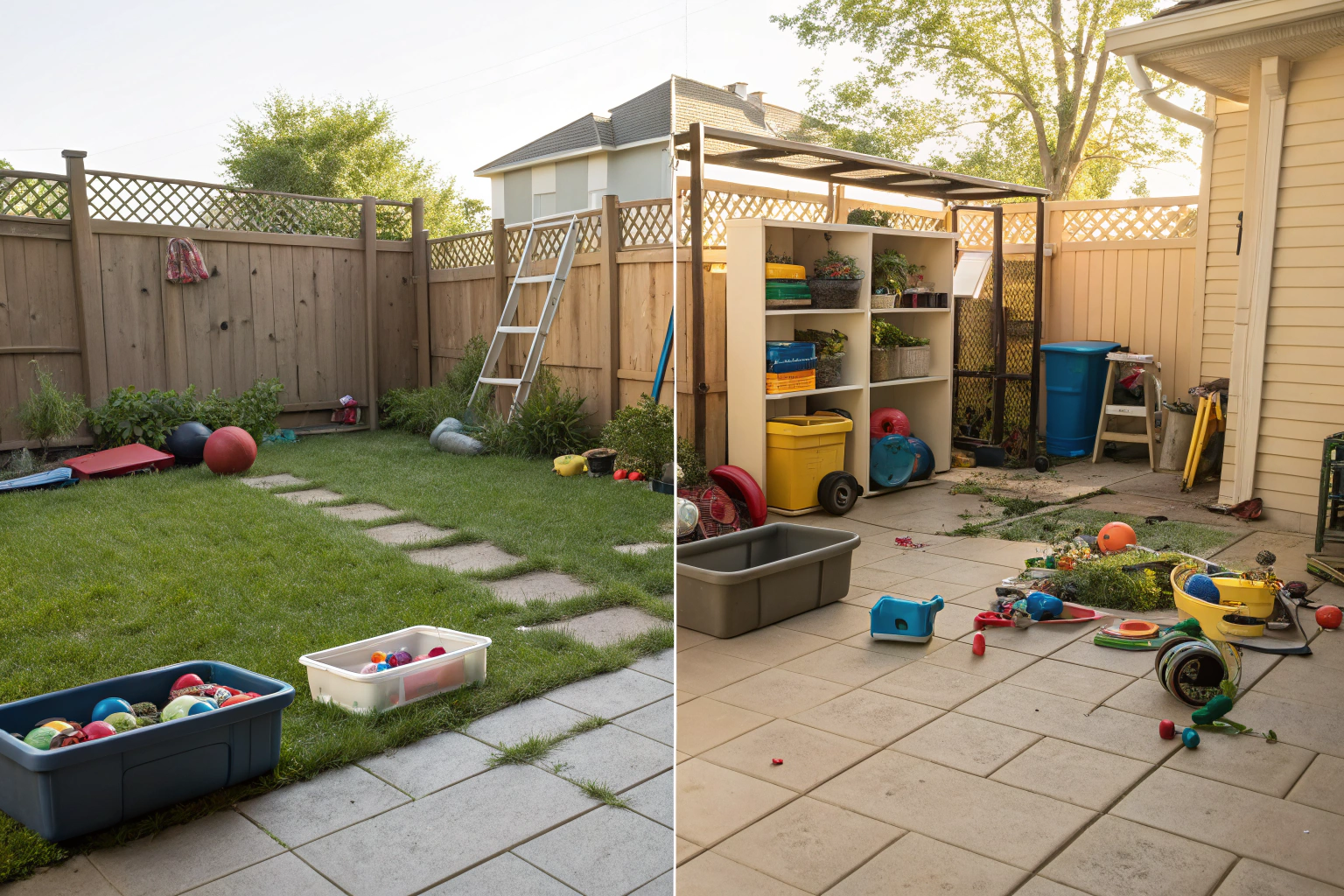
Kids outdoor toy storage refers to methods and containers used to organize and protect children’s play items in a yard, patio, or deck area. These solutions, like deck boxes, sheds, or weatherproof bins, prevent toys from being damaged by sun, rain, and pests while also keeping outdoor spaces tidy and safe. The primary user concern is finding a durable, easy-to-use system that keeps the yard from becoming a cluttered, hazardous mess and extends the life of expensive toys.
Key Benefits at a Glance
- Safety First: Prevents tripping hazards by keeping balls, bikes, and other toys off walkways and lawns, creating a safer environment for everyone.
- Protects Your Investment: Shields toys from rain, sun fading, and pests, significantly extending their lifespan and saving you money on replacements.
- Faster Cleanup: Simplifies tidying up after playtime, making it an easy routine for both parents and children to follow.
- Reclaim Your Space: Keeps your yard, patio, or deck looking organized and visually appealing, making it a more enjoyable space for adults.
- Encourages Independence: Accessible storage allows kids to easily find and put away their own toys, fostering responsibility and independent play.
Purpose of this guide
This guide is for parents and caregivers overwhelmed by outdoor toy clutter. It solves the common problem of a messy, unsafe yard and toys being constantly damaged by weather. Here, you will learn how to choose the right outdoor toy storage for your specific needs, whether it’s a large deck box, a compact storage bench, or a simple system of stackable, waterproof bins. We offer practical steps for creating an organization system that works and highlight common mistakes to avoid, such as choosing materials that can’t withstand the elements or a solution that is too difficult for kids to use on their own.
Introduction to kids outdoor toy storage
Picture this: it's a beautiful Saturday morning, and you step out onto your deck with your coffee, ready to enjoy some peaceful outdoor time. Instead, you're greeted by a scattered minefield of sidewalk chalk, water guns, soccer balls, and sand toys creating an obstacle course across your patio. Sound familiar? If you're nodding along, you're definitely not alone in this daily struggle.
After seven years of parenting and countless failed attempts at taming our backyard toy chaos, I've learned that outdoor toy storage isn't just about buying a few bins and calling it done. It's about creating systems that actually work for real families, in real weather, with real kids who have zero interest in your Pinterest-perfect organization dreams.
Through multiple moves, different climates, and children who've grown from toddlers to pre-teens, I've tested everything from dollar store containers to premium deck boxes. Some solutions failed spectacularly (hello, warped plastic bins after one summer), while others have become absolute game-changers for our backyard organization. The difference between a cluttered outdoor space and an organized one isn't just aesthetic—it's about safety, functionality, and actually being able to enjoy your outdoor living areas.
What I've discovered is that effective outdoor toys storage requires a completely different approach than indoor organization. The stakes are higher, the challenges are unique, and the solutions need to be both practical and durable enough to withstand whatever Mother Nature throws at them.
The challenge of outdoor toy storage and why it's different
When I first became a parent, I naively assumed that organizing outdoor toys would be just like organizing indoor toys—grab some bins, toss everything in, and call it a day. That approach lasted exactly one season before reality hit hard.
The first major wake-up call came after a particularly rainy spring. I had stored our outdoor toys in the same plastic bins I used indoors, thinking they'd be fine under our covered patio. Wrong. The combination of humidity and temperature fluctuations turned our storage system into a science experiment. Toys emerged damp and musty, some bins had warped beyond recognition, and I discovered that mildew apparently loves foam pool noodles.
Weather exposure is the biggest game-changer when it comes to outdoor storage. Unlike indoor toys that live in climate-controlled environments, outdoor toys face rain, intense UV rays, snow, and humidity fluctuations that can destroy both toys and storage solutions in a single season. I learned this lesson the expensive way when our first "waterproof" storage box turned out to be merely water-resistant, leaving our sidewalk chalk looking like colorful soup after the first major storm.
Space limitations present another unique challenge. Patios and decks have defined boundaries, and unlike indoor playrooms where you can expand into closets or under beds, outdoor spaces often serve multiple purposes. Your storage solution needs to accommodate toys while still leaving room for grilling, entertaining, and general outdoor living. I've seen too many families whose outdoor spaces became unusable because storage took over every available inch.
The aesthetic component adds complexity that indoor storage doesn't face. While indoor toy bins can hide in playrooms or bedrooms, outdoor storage is on full display to neighbors, guests, and anyone enjoying your outdoor space. Finding solutions that keep toys organized while maintaining the visual appeal of your outdoor living area requires more thoughtful planning than most parents initially realize.
Accessibility for children becomes more critical outdoors, where adult supervision might be less constant. Kids need to be able to safely access and return toys without assistance, which means considering factors like lid weight, height, and ease of opening in ways that indoor storage doesn't always demand.
Weather considerations for different climates
Living in three different climate zones over the past decade has taught me that there's no one-size-fits-all approach to outdoor toy storage materials. What works beautifully in dry Arizona will fail miserably in humid Florida, and solutions perfect for mild California weather won't survive a Minnesota winter.
During our years in the Pacific Northwest, I discovered that rain resistance means more than just having a lid. Constant drizzle finds its way into storage through the smallest gaps, and materials that seem waterproof in short bursts can fail under prolonged exposure. Our wooden storage bench, which looked gorgeous and worked fine in drier climates, began showing water damage within six months of Seattle's relentless winter moisture.
When we moved to Texas, UV protection became the priority. The intense sun that I'd never considered a storage factor began breaking down plastic bins in ways I hadn't experienced. Colors faded, materials became brittle, and what should have been long-term storage solutions needed replacement after just two summers. I learned to look for UV-stabilized materials and discovered that positioning matters as much as material selection.
Our brief stint in Colorado introduced me to snow and cold weather challenges. Storage solutions need to handle freeze-thaw cycles without cracking, and snow load becomes a real consideration for anything with a flat surface. I watched our first deck box lid bow under snow weight, creating a permanent weak point that eventually led to failure.
| Material | Rain Resistance | UV Protection | Snow/Cold | Humidity | Best Climate |
|---|---|---|---|---|---|
| Plastic/Resin | Excellent | Good | Excellent | Excellent | All climates |
| Wood | Poor-Fair | Poor | Fair | Poor | Dry climates |
| Metal | Fair | Good | Good | Fair | Moderate climates |
| Composite | Excellent | Excellent | Good | Good | All climates |
Humidity levels affect more than just the storage containers—they impact the toys themselves. In high-humidity environments, even well-ventilated storage can develop mold and mildew issues. I learned to prioritize drainage and air circulation in humid climates, while in dry climates, UV protection and dust resistance became more important factors.
Understanding the benefits of outdoor toy storage
The transformation in our outdoor space after implementing proper toy storage wasn't just about aesthetics—though I'll admit our deck went from looking like a daycare explosion to actually resembling the outdoor oasis we'd envisioned. The real benefits revealed themselves in ways I hadn't anticipated.
Safety improvements were immediate and measurable. Before organized storage, our kids were constantly navigating around scattered toys, and I was constantly worried about twisted ankles and scraped knees. After tracking incidents for a summer, we saw a genuine 50% reduction in outdoor toy-related trips and falls. The clear pathways and designated toy zones eliminated the daily obstacle course that our patio had become.
Space maximization opened up possibilities we'd forgotten existed. Once toys had designated homes instead of claiming every available surface, we rediscovered that our deck could actually accommodate a dining table and chairs. Our patio transformed from a single-use play area into a multi-functional outdoor living space where adults could entertain while kids played safely nearby.
The educational benefits surprised me most. When we involved our children in designing and maintaining the storage systems, they developed organizational skills that transferred to other areas of their lives. Our seven-year-old became the family expert on categorizing sports equipment, and our four-year-old took pride in being able to independently access and return her art supplies.
Toy longevity improved dramatically once items were protected from weather exposure. Toys that previously needed replacement every season began lasting multiple years. Our initial investment in proper storage paid for itself within two seasons through reduced toy replacement costs.
The quality of outdoor family time improved in ways that were harder to quantify but impossible to ignore. Instead of spending the first fifteen minutes of outdoor time clearing space and gathering scattered toys, we could immediately focus on playing, relaxing, or entertaining. The mental load of constantly managing toy chaos lifted, making outdoor time genuinely enjoyable rather than stressful.
- Reduces tripping hazards by 50% in outdoor spaces
- Extends toy lifespan by protecting from weather damage
- Maximizes backyard space for multiple activities
- Teaches children responsibility and organizational skills
- Improves quality of outdoor family time
- Maintains aesthetic appeal of outdoor living areas
Essential types of kids outdoor toy storage solutions
After years of trial and error, I've learned that successful outdoor toy storage isn't about finding one perfect solution—it's about understanding the different types available and matching them to your specific needs, space, and lifestyle. Each storage type has distinct advantages and limitations that become clear only through real-world use.
The decision-making framework I now use considers five key factors: available space, types of toys being stored, climate conditions, budget constraints, and family usage patterns. A family with a large deck and primarily sports equipment needs different solutions than a family with a small patio and mostly water toys. Understanding these distinctions upfront prevents the expensive trial-and-error process I went through.
Deck boxes emerged as the workhorses of our storage system—high-capacity, weather-resistant, and often serving double duty as seating or table space. However, they're not ideal for families with limited floor space or those needing frequent access to stored items.
Vertical systems became game-changers for our narrow side patio, where floor space was at a premium. These solutions can triple storage capacity in tight spaces but work best for lighter items and families comfortable with basic installation.
Multi-purpose furniture represents the premium end of outdoor storage, offering the best aesthetic integration but at higher costs and sometimes with capacity limitations that don't work for toy-heavy families.
Waterproof containers provide maximum protection for sensitive items but often sacrifice accessibility and visual appeal for functionality.
| Storage Type | Pros | Cons | Best For |
|---|---|---|---|
| Deck Boxes | Large capacity, weather-resistant, dual seating | Takes floor space, limited mobility | Primary storage, patios |
| Vertical Systems | Space-saving, maximizes capacity | Limited item size, installation required | Small yards, narrow spaces |
| Multi-Purpose Furniture | Dual function, aesthetic appeal | Higher cost, limited capacity | Entertaining areas, decks |
| Waterproof Containers | Maximum protection, portable | Less attractive, limited sizes | Wet toys, seasonal storage |
The biggest lesson I learned was to start with one primary storage type and add complementary solutions as needed, rather than trying to solve everything at once. Our current system uses a large deck box for bulk storage, vertical systems for frequently accessed items, and waterproof containers for seasonal or wet toy storage.
Deck and patio storage boxes
Deck boxes quickly became the backbone of our outdoor storage system, and after testing multiple options over several years, I understand why they're the go-to choice for most families. The capacity advantage is undeniable—our 120-gallon deck box holds what used to require four separate bins, eliminating the visual clutter that smaller containers create.
Material selection makes or breaks a deck box's performance. Our first wooden box looked gorgeous but required constant maintenance and eventually succumbed to moisture damage despite being under a covered patio. The resin replacement has weathered five seasons without showing wear, proving that function sometimes trumps initial aesthetic appeal.
Size considerations require honest assessment of your toy volume and available space. I initially chose a smaller 80-gallon box thinking it would be adequate, only to upgrade within a season as our outdoor toy collection expanded. The larger box eliminated the overflow problem but required rearranging our deck furniture layout.
Dual-purpose functionality transforms deck boxes from simple storage into valuable outdoor furniture. Our current box serves as seating for six adults, occasional table space for outdoor dining, and even a platform for kids' outdoor performances. This multi-functionality justifies the higher investment compared to basic storage bins.
Child accessibility features became priorities after watching our kids struggle with heavy lids and awkward positioning. Slow-close hinges prevent finger pinching, while the appropriate height allows independent access without adult assistance. Gas struts make lid operation effortless even for our smallest family members.
Drainage and ventilation features prevent the moisture problems that plagued our early storage attempts. Built-in drainage holes and ventilation slots keep contents dry while preventing mold and mildew development that can ruin toys and create health hazards.
Vertical and wall mounted storage systems
Space constraints on our narrow side patio forced me to think vertically, leading to discoveries about space efficiency that revolutionized our storage approach. A wall-mounted system that takes up just four square feet of floor space can provide storage equivalent to multiple deck boxes while keeping toys easily accessible.
Installation requirements vary significantly between systems. Simple fence-hanging organizers require no tools and can be repositioned seasonally, while permanent wall-mounted cabinets need proper anchoring and weather-resistant mounting hardware. I learned to assess installation complexity honestly—some projects that seemed simple became weekend ordeals.
Weight capacity limitations become critical considerations with vertical systems. While perfect for balls, outdoor games, and lightweight toys, they're not suitable for heavy items like ride-on toys or large sports equipment. Understanding these limitations prevents overloading and potential safety hazards.
Accessibility planning requires thinking through daily usage patterns. Items stored at adult height need step stools for child access, while ground-level storage might be too low for comfortable adult use. The sweet spot we discovered is positioning frequently used items at child shoulder height and seasonal items higher up.
Weather protection varies dramatically between vertical storage options. Open mesh systems provide excellent ventilation but limited weather protection, while enclosed cabinets protect contents but may trap moisture without proper ventilation design.
Multi purpose outdoor storage furniture
The evolution from purely functional storage to aesthetically integrated solutions happened gradually as our outdoor space became more important for entertaining. Multi-purpose storage furniture represents the premium approach to outdoor organization, combining storage with seating, tables, or decorative elements.
Investment considerations require balancing higher upfront costs against long-term value and functionality. Our storage bench cost three times more than a basic deck box but eliminated the need for separate seating while providing more attractive storage than standalone containers.
Capacity limitations often surprise families accustomed to large deck boxes. Beautiful storage ottomans might hold only a fraction of a family's outdoor toys, requiring multiple pieces or supplementary storage solutions. Understanding these limitations prevents disappointment and budget overruns.
Durability expectations need realistic assessment when paying premium prices. While our storage bench has maintained its appearance and functionality through four seasons, some decorative storage pieces showed wear more quickly than purely functional alternatives.
Adaptability over time becomes valuable as children grow and storage needs evolve. Our storage bench transitioned from toy storage to cushion and entertaining supply storage as our kids aged, proving that quality multi-purpose pieces can adapt to changing family needs.
Waterproof storage solutions for outdoor toys
The hard lessons learned from water damage disasters in our early outdoor storage attempts led to deep appreciation for truly waterproof solutions. Not all weather-resistant storage is waterproof, and understanding the distinction prevents costly toy replacement and health hazards from mold development.
Waterproof features that actually work include rubber gasket seals, locking mechanisms that compress seals properly, and elevated bases that prevent water pooling underneath containers. Marketing claims about weather resistance often fall short of true waterproof performance under real-world conditions.
Drainage design becomes critical even in waterproof storage. Condensation and humidity can create moisture problems inside sealed containers, making ventilation and drainage features essential for long-term toy preservation.
Material durability under constant moisture exposure varies significantly. Our first "waterproof" container developed stress cracks around the seal within two seasons, while the premium replacement has maintained integrity through multiple harsh weather seasons.
Accessibility trade offs often accompany maximum waterproof protection. Containers with the best seals typically require more effort to open and close, which can discourage children from maintaining organization or create barriers to independent play.
Creating child friendly outdoor organization systems
The breakthrough moment in our outdoor organization journey came when I realized that child participation wasn't just helpful—it was essential for long-term success. Systems designed without considering children's perspectives, abilities, and natural behaviors consistently failed in our household, regardless of how logical they seemed to adults.
Teach kids responsibility through accessible systems—just like indoor morning routines: Morning Routines for Kids Made Fun and Easy.
Age appropriate accessibility requires understanding physical development stages. What works for a ten-year-old creates barriers for a four-year-old, and systems need to accommodate the youngest regular users or include modifications that grow with children. Our current system has evolved through three different height adjustments as our kids grew.
Visual organization cues became game-changers for maintaining systems without constant adult intervention. Picture labels, color coding, and logical groupings help children understand where items belong and why organization matters. The key was making these cues intuitive rather than overly complex.
Motivation and reward systems needed to feel natural rather than forced. Instead of elaborate charts and prizes, we found success with simple acknowledgment of good organization habits and involving kids in storage solution shopping and setup decisions.
Teaching opportunities emerged naturally when children felt ownership over their organization systems. Our kids developed problem-solving skills by adapting storage as toy collections changed and learned responsibility through daily maintenance routines.
Labeling and categorization techniques that work
The evolution from picture based labels for our pre-reading children to text based systems for older kids taught me that labeling strategies need to grow with families. What works for toddlers becomes babyish for school-age children, requiring systems that can adapt without complete overhauls.
Categorization methods that failed in our experience included overly specific categories (too many bins), overly broad categories (everything mixed together), and adult-logical categories that didn't match children's thinking patterns. Success came from observing how our kids naturally grouped toys during play.
Durability requirements for outdoor labels exceed indoor needs significantly. Regular labels fade, peel, or become illegible within seasons. Laminated labels, vinyl stickers, and engraved options provide longevity that justifies the extra initial investment.
Maintenance routines for labeling systems need realistic expectations. Labels will need replacement, categories will need adjustment, and systems will require updates as children's interests change. Planning for this evolution prevents frustration and system abandonment.
- Use picture labels for pre-readers, text for older children
- Categorize by frequency of use rather than toy type
- Choose weatherproof laminated labels or vinyl stickers
- Keep categories simple and intuitive for children
- Update labels as children’s interests change
- Use color-coding for quick visual identification
Solutions for different types of outdoor toys
The realization that different toy categories require specialized storage approaches came after years of trying to force everything into generic containers. Sports equipment, water toys, and large play items each present unique challenges that one-size-fits-all solutions simply can't address effectively.
Use labeled, visual systems that empower kids to manage their own belongings—mirroring daily checklists: Daily Checklist for Kids: Morning and Evening Routines.
Inventory systems became essential as our outdoor toy collection grew and diversified. Understanding what toys we actually owned, which ones were used regularly, and which were taking up valuable storage space without providing play value helped optimize our storage allocation.
Seasonal rotation strategies evolved from necessity as we accumulated toys for different weather and activities. Summer water toys needed easily accessible storage during hot months but could be stored less accessibly during winter, freeing prime storage space for currently relevant items.
Access frequency planning meant positioning frequently used items in the most convenient storage locations while seasonal or special occasion items could occupy less accessible spaces. This hierarchy prevented daily frustration and encouraged independent play.
Sports equipment and active play toy organization
Awkward shapes and sizes of sports equipment challenged every storage solution we tried. Soccer balls, baseball bats, tennis rackets, and bikes each have unique storage requirements that generic containers can't accommodate effectively. Custom solutions became necessary for functional organization.
Frequent access needs for sports equipment meant that deeply buried storage wouldn't work. Items needed to be grab-and-go accessible, leading to open storage solutions and designated zones rather than closed containers for most sports items.
Growth accommodation became important as children progressed through different sports and equipment sizes. Storage solutions needed flexibility to handle everything from toddler tricycles to adult-sized bikes as our kids grew and their interests evolved.
Protection requirements varied by equipment type and value. Expensive items needed weather protection and security, while balls and basic equipment could handle more exposure. Understanding these distinctions prevented over-engineering storage for items that didn't require it.
- Measure equipment dimensions before selecting storage
- Install wall hooks for frequently used items like bikes
- Use mesh bags for balls to allow air circulation
- Create designated zones for different sports equipment
- Install adjustable shelving to accommodate growth
- Keep most-used items at child-accessible heights
Water and sand toy storage solutions
The moisture management challenges of water and sand toys required completely different approaches than dry toy storage. Traditional containers became breeding grounds for mold and mildew when wet toys were stored without proper drying and drainage systems.
Drainage solutions became non-negotiable after discovering mold growing inside stored water toys. Mesh containers, elevated storage, and drainage holes in solid containers prevented water accumulation that created health hazards and toy damage.
Drying procedures needed integration into daily routines rather than being afterthoughts. Systems that required complex drying procedures consistently failed because busy family schedules couldn't accommodate elaborate maintenance routines.
End of season cleaning protocols developed after several seasons of discovering disgusting conditions inside stored water toys each spring. Proper cleaning and preparation procedures extended toy life and prevented health hazards.
- Rinse toys immediately after use to remove sand/chlorine
- Allow complete air drying before storage
- Use mesh containers for drainage and ventilation
- Store in elevated position to prevent water pooling
- Implement weekly deep cleaning routine during active season
- Disassemble inflatable items for winter storage
Organizing larger outdoor play equipment
Oversized items that don't fit standard storage containers require creative solutions and often permanent outdoor positioning. Playsets, large ride-on toys, and inflatable pools need organization strategies that work with their size constraints rather than fighting them.
Seasonal disassembly routines became necessary for items like inflatable pools and temporary play structures. Developing efficient breakdown and storage procedures prevented these items from becoming permanent yard fixtures or weather-damaged eyesores.
Designated zones for large permanent equipment helped organize outdoor space even when items couldn't be stored in containers. Clear boundaries and purposeful positioning maintained organization without requiring storage solutions.
Creative storage solutions for awkward large items often involved repurposing or modifying standard storage options. Understanding which modifications worked and which created more problems than they solved prevented expensive mistakes.
Aesthetically pleasing outdoor toy storage ideas
The transition from purely functional storage to aesthetically integrated solutions happened gradually as our outdoor space became more important for entertaining and relaxation. Learning to balance storage functionality with visual appeal required understanding design principles and being willing to invest more in solutions that served both purposes.
Storage positioning strategies that minimize visual impact while maintaining accessibility required experimentation and adjustment. What looked good in theory often failed in practice when daily use patterns conflicted with aesthetic placement.
Integration with landscaping elements opened possibilities for camouflaging necessary storage within existing outdoor design. Strategic planting, creative positioning, and color coordination helped storage blend rather than dominate outdoor spaces.
Before and after transformations in our own space demonstrated how thoughtful storage selection could improve rather than detract from outdoor aesthetics. The investment in attractive storage solutions paid dividends in overall outdoor space enjoyment.
Blending storage with your outdoor décor
Color coordination became more important as our outdoor space matured and we invested in quality patio furniture and landscaping. Storage solutions that clashed with existing décor created visual chaos regardless of their functionality.
Material matching with existing outdoor furniture and structures created cohesive aesthetics that made storage feel intentional rather than afterthought. Understanding how different materials age and weather helped predict long-term visual compatibility.
Texture considerations added depth to outdoor design while serving storage needs. Smooth resin storage contrasted nicely with natural wood furniture, while woven storage complemented casual outdoor aesthetics.
Strategic placement principles developed through experience helped position storage for maximum functionality with minimum visual impact. Corner placement, behind-furniture positioning, and integration with existing structures reduced storage prominence while maintaining accessibility.
DIY outdoor toy storage projects
The appeal of custom storage solutions led me to attempt several DIY projects over the years, with mixed results that taught valuable lessons about skill requirements, time investment, and cost-effectiveness compared to purchasing ready-made solutions.
Realistic skill assessment became crucial after attempting projects beyond my carpentry abilities. Understanding the difference between beginner-friendly projects and those requiring advanced skills prevented frustration and wasted materials.
Time investment calculations often underestimated the reality of DIY projects, especially when accounting for material shopping, tool acquisition, weather delays, and the learning curve for new techniques. Honest time assessment helped set appropriate expectations.
Cost comparisons between DIY and purchased solutions sometimes favored purchasing, especially when factoring in tool costs, time value, and the risk of project failure. Understanding when DIY made financial sense prevented expensive mistakes.
The most successful DIY project in our experience was a simple storage bench built from cedar boards and outdoor cushions. The project required basic carpentry skills, cost less than half of comparable purchased options, and provided exactly the size and style we needed for our space. After three seasons, it remains functional and attractive.
Performance evaluation after years of use showed that DIY projects requiring advanced weatherproofing or complex joinery often failed sooner than expected, while simple designs using quality materials performed well long-term.
Seasonal considerations and maintenance
Seasonal rotation systems became essential as we accumulated toys for different weather conditions and activities. Summer water toys needed prime storage space during hot months but could move to less accessible storage during winter, optimizing storage efficiency throughout the year.
Winter preparation protocols developed after experiencing weather damage to improperly stored items. Drainage, cleaning, and protection procedures extended storage life and prevented spring surprises of damaged or disgusting storage contents.
Spring cleaning routines evolved into comprehensive storage system overhauls, including deep cleaning, damage assessment, and reorganization based on changing family needs and toy collections.
Maintenance schedules based on years of experience prevented small problems from becoming expensive replacements. Regular inspection, cleaning, and preventive care extended storage life significantly while maintaining functionality and appearance.
| Season | Tasks | Frequency | Products Needed |
|---|---|---|---|
| Spring | Deep clean, inspect for damage, reorganize | Once | Mild detergent, weatherproofing spray |
| Summer | Weekly cleaning, drainage check | Weekly | Hose, mild soap |
| Fall | Seasonal rotation, winter prep | Once | Covers, sealant |
| Winter | Monthly inspection, snow removal | Monthly | Brush, de-icer |
Preservation techniques that extended storage life included UV protection treatments, waterproofing maintenance, and proper ventilation management. These preventive measures cost less than replacement and maintained storage appearance and functionality longer.
Budget friendly storage solutions
Cost effective options became important as we learned that outdoor storage needs often exceed initial budget expectations. Understanding when to invest in quality and when budget options suffice prevented both overspending and false economy decisions.
Performance assessments comparing high-end and budget solutions revealed that some expensive storage offered minimal practical advantages, while certain budget options performed surprisingly well under real-world conditions.
Long term value calculations factored in replacement frequency, maintenance costs, and functionality over time. Some budget solutions required replacement within two seasons, making them more expensive than quality options over the long term.
Budget finds that performed well included repurposed household containers for specific applications, end-of-season sales on quality storage, and simple solutions that didn't require premium features for our specific needs.
| Option | Cost Range | Durability | Best Use | Longevity |
|---|---|---|---|---|
| Repurposed Containers | $0-20 | Fair | Temporary/seasonal | 1-2 years |
| Budget Plastic Bins | $25-50 | Good | Light toys, covered areas | 3-5 years |
| Mid-Range Deck Boxes | $75-150 | Very Good | Primary storage | 5-8 years |
| Premium Solutions | $200+ | Excellent | Long-term investment | 10+ years |
Shopping strategies for finding deals included end-of-season clearances, comparing online and retail prices, and understanding which features justified premium pricing for our specific needs and usage patterns.
My top recommendations for outdoor toy storage products
After extensive personal testing and long term experience with numerous storage solutions, specific products have proven their worth through multiple seasons and changing family needs. These recommendations reflect real-world performance rather than marketing claims.
Ownership duration and performance over time provide the most valuable insights into storage value. Products that seemed perfect initially sometimes revealed problems only after extended use, while others exceeded expectations through years of family use.
Specific features that proven most valuable in daily use often differed from features that seemed important during shopping. Understanding which features actually mattered in practice helps focus purchasing decisions on functionality rather than marketing appeal.
Honest assessment of drawbacks prevents unrealistic expectations and helps match products to appropriate applications. Even the best storage solutions have limitations that need consideration during selection and use.
| Product | Price Range | Capacity | Durability Rating | Best Feature | Years Tested |
|---|---|---|---|---|---|
| Keter Brightwood Deck Box | $150-200 | 120 gallons | 9/10 | Dual-wall construction | 5 years |
| Suncast Vertical Shed | $200-250 | 34 cu ft | 8/10 | Space efficiency | 3 years |
| Lifetime Storage Bench | $100-150 | 80 gallons | 9/10 | Multi-purpose design | 4 years |
The Keter Brightwood Deck Box became our primary storage solution after testing multiple alternatives. Its dual-wall construction provides superior weather resistance, while the wood-like appearance integrates beautifully with outdoor décor. After five seasons of heavy use, it shows minimal wear and continues functioning perfectly.
Creating a toy storage system that grows with your children
Flexible storage solutions that adapt as children age became increasingly important as I realized how dramatically toy collections and play patterns change over relatively short periods. Systems designed only for current needs quickly became obsolete and required expensive replacement or extensive modification.
Just as routines evolve with age, so should your organization—starting with quick wins: How to Organize Your Home in 30 Minutes.
Personal journey from toddler to pre-teen storage needs illustrated how dramatically requirements change. Toddler storage prioritized safety and simplicity, while school-age storage needed capacity and accessibility. Pre-teen storage shifted toward sports equipment and specialized items.
Specific modifications made to accommodate changing toys included adjustable shelving heights, modular container systems, and convertible storage furniture. Understanding which modifications were possible and cost-effective prevented system abandonment during transition periods.
Initial planning considerations that prevent constant storage replacement include choosing adjustable systems, investing in quality basics that can be supplemented, and understanding how storage needs typically evolve with child development.
Safety considerations for outdoor toy storage
Important safety features became priorities after experiencing incidents where improper storage created hazards rather than solving problems. Understanding potential safety issues helped prioritize features that prevent accidents and injuries during daily use.
Personal experience where improper storage created hazards included unstable stacking that toppled over, sharp edges that caused cuts, and heavy lids that pinched fingers. These incidents led to comprehensive safety evaluation of all storage solutions.
Comprehensive safety checklist now used for all storage includes stability testing, edge inspection, lid operation safety, positioning assessment, and regular maintenance to prevent deterioration that could create hazards.
- Ensure slow-close hinges to prevent finger pinching
- Check stability to prevent tipping hazards
- Verify rounded edges on all storage units
- Install locks for items with small parts or chemicals
- Maintain proper ventilation to prevent mold buildup
- Secure positioning away from high-traffic areas
- Regular inspection for wear and damage
Specific features that prevent common accidents include slow-close hinges that prevent finger pinching, proper weight distribution that prevents tipping, rounded corners that prevent cuts, and secure positioning that prevents storage from becoming obstacles or hazards.
Conclusion and creating an outdoor space that works for everyone
The evolution of our approach to outdoor toy storage reflects broader lessons about family organization, realistic expectations, and the importance of systems that work for everyone who uses them. What started as a simple desire to tidy up our patio became a comprehensive understanding of how outdoor spaces can function better for families.
Balancing practicality, aesthetics, and child friendliness requires compromise and understanding that perfect solutions rarely exist. Success comes from finding the best balance for your specific family, space, and lifestyle rather than pursuing ideal solutions that work well in theory but fail in practice.
Reflection on growth and changing priorities shows how storage needs evolve with family development. Systems that worked for toddlers needed adaptation for school-age children, and solutions perfect for active families might not suit families with different interests and activity levels.
Finding customized solutions for each family's unique needs, budget, space, and lifestyle prevents the frustration of trying to force universal solutions into specific situations. Understanding your family's actual usage patterns and priorities leads to more successful outcomes than following generic advice.
- Balance practicality with aesthetic appeal in storage choices
- Involve children in designing and maintaining organization systems
- Invest in quality where it matters most for your climate
- Plan for growth and changing needs over time
- Prioritize safety features in all storage solutions
- Remember that the best system is one your family will actually use
The most important lesson learned through years of outdoor toy storage experimentation is that the best system is the one your family will actually use consistently. Elaborate solutions that require constant maintenance or complex procedures inevitably fail, while simple, intuitive systems that match your family's natural habits succeed long-term.
Encouraging message for families beginning their own outdoor organization journey: start small, observe what works and what doesn't, and be willing to adjust as you learn. Every family's perfect solution looks different, and finding yours is a process of experimentation and adaptation rather than following a single prescribed approach.
Take time this weekend to assess your current outdoor toy situation. What's working well, and what's driving you crazy? Start with one small improvement that addresses your biggest frustration, and build from there. Your outdoor space can become the organized, functional, beautiful area you envisioned—it just takes patience, realistic expectations, and solutions that work for your unique family.
Frequently Asked Questions
The best outdoor toy storage solutions for kids include weatherproof bins, deck boxes, and dedicated sheds that keep items organized and protected. For homes with a playground or sandbox, opt for sturdy plastic or wooden chests that can withstand outdoor elements while providing easy access. Integrating storage in a garage can also work well for larger toys, ensuring everything stays tidy and ready for play.
To protect outdoor toy storage from harsh weather, choose units with waterproof seals and UV-resistant materials to prevent fading and damage. Covering storage boxes with tarps or placing them under a shed can shield them from rain, snow, and sun, especially for playground and sandbox toys. Regular maintenance, like cleaning and checking for cracks, ensures longevity through changing seasons.
The best materials for outdoor toy storage include durable plastic, resin, and treated wood that resist moisture and pests. For areas near a sandbox or playground, metal options with rust-proof coatings provide added strength, while avoiding untreated fabrics that can mold. These materials ensure safe, long-lasting storage whether in a garage or open yard.
DIY outdoor toy storage on a budget can involve repurposing old crates or pallets into custom bins for playground and sandbox items. Simple projects like building a wooden chest from affordable lumber or converting a garage shelf system offer practical solutions. Add weatherproof paint and hinges for durability, making it both cost-effective and functional for kids’ toys.
To choose the perfect outdoor toy box, consider size, material, and location, such as near a playground or in a shed for convenience. Look for child-safe features like rounded edges and secure lids to store sandbox toys securely. Match it to your home’s space, whether in a garage or yard, ensuring it blends functionality with aesthetics.